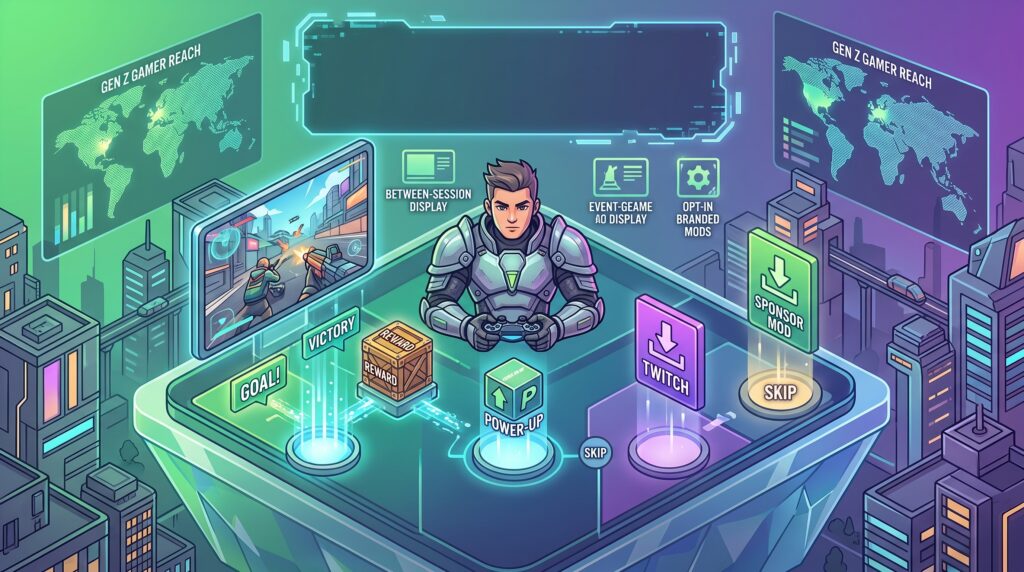
Short answer: Gen Z responds to ad formats that sit inside gameplay itself, triggered by something the player just did or something they chose to install, and largely ignores formats that pause or block the experience to demand attention. Below is the full case for why, along with how the leading gaming-native options stack up against each other.
The Numbers Behind the Shift
Three data points explain why this matters now rather than in some hypothetical future. Deloitte’s 2025 Digital Media Trends survey found that 90% of Gen Z identify as gamers. The Entertainment Software Association’s 2026 Essential Facts report puts weekly video game play among Americans at 212.3 million people. And a 2025 Youth Insight survey found that 60% of young respondents describe repeated ad exposure as somewhat or extremely intrusive.
Read together, these numbers describe an audience that’s overwhelmingly reachable through games, and simultaneously trained to reject the interruption format most media plans still default to. That’s a targeting problem with a specific, addressable cause.
Why the Old Playbook Stopped Working
The skip reflex is the compounding result of a decade of skip buttons, ad blockers, and unskippable pre-roll that taught an entire generation to treat interruption as a tax on using the internet.
That reflex is now colliding with a weaker brand-safety environment. The Global Alliance for Responsible Media discontinued its activities in 2024 following a legal dispute, and platforms have been left to write their own suitability standards since. A Kapwing analysis of Social Blade data, cited by eMarketer, found that more than one in five videos recommended by YouTube’s algorithm now qualify as AI-generated “slop.” DoubleVerify’s 2025 Global Insights report found that 65% of marketing decision-makers are actively concerned about placement suitability on social platforms.
Put plainly: the audience has less patience for interruption, and the inventory most interruption formats run on has gotten harder to trust. Both trends point in the same direction.
What Non-Intrusive In-Game Advertising Actually Looks Like
“Non-intrusive” describes formats built to sit inside a moment the player is already committed to, rather than formats that ask the player to pause what they’re doing.
Three structural patterns show up across the credible options in this category:
- Between-session placements. Standard display and video units served through desktop gaming apps and gaming-adjacent websites, timed for the moment between matches. This is the format most likely to resemble familiar IAB media, just repositioned to a moment when attention is actually available.
- Event-triggered creative. Instead of a fixed slot that runs no matter what’s happening, this format fires from something the player just did, a win, a goal, a specific milestone, and pairs the brand exposure with an in-game reward. It works because the ad becomes part of the reward loop.
- Opt-in integrations. Brand content built directly into playable mods or downloadable content the player actively chooses to install. This format carries a different kind of consent than anything served automatically, since nobody encounters a mod by accident.
Layered underneath all three is the audience-targeting question. Deterministic, first-party gameplay and hardware data, the kind collected through actual play rather than inferred from a like or a follow, lets a targeting engine work from real behavioral signals: session length, time of day, genre. That’s a materially different data foundation than anything built on inferred social interest, and it’s what makes the format choices above actually addressable at scale.
None of this removes the need for good creative or honest measurement. A contextual trigger still has to earn the moment it interrupts, so to speak. Showing up around a win, a loss, or a goal reads as support when the execution respects the moment, and as noise when it doesn’t.
Overwolf Ads vs. Twitch vs. Anzu: How the Leading Options Compare
The three names that come up most often when evaluating gaming as a Gen Z channel each solve a different piece of the problem. Here’s how they stack up on the dimensions that actually determine whether a format gets skipped.
| Evaluation Dimension | Overwolf Ads | Twitch | Anzu |
| Player state during exposure | Active play (in-session triggers) or between sessions | Watching a stream (leanback, not playing) | Active play |
| Core ad mechanic | Event-triggered creative tied to gameplay moments, plus opt-in branded mods | Pre-roll and mid-roll video during a live stream | Static intrinsic placements |
| Reward or opt-in signal | Yes, rewarded formats pair exposure with an in-game reward; mods are actively downloaded | No, pre-roll is a standard interruption format | No, placements are passive and don’t trigger from player action |
| Title tier reached | Premium AAA and mid-core PC titles | Whatever title the streamer happens to be playing | Primarily smaller, made-for-advertising mobile titles |
The read-out here is fairly direct. Twitch’s ad experience is closer to a video platform’s than a game’s. Anzu sits inside gameplay, but its placements are passive and its inventory skews toward smaller mobile titles rather than the premium PC catalog where Gen Z sessions run longest. Overwolf Ads is built around the ad triggers from something the player did, and it happens inside titles people are already spending hours in.
Bottom Line
If the goal is reaching Gen Z without adding to the pile of ads they’ve learned to skip, format matters more than platform size. Interruption-based buys, wherever they run, are fighting an audience that’s had over a decade of practice tuning them out. Formats that trigger from player behavior or require an active opt-in are working with that behavior and the reach numbers behind them suggest that it’s close to the default audience.
FAQs
Q: What’s the actual difference between reaching Gen Z through gaming versus social media?
A: Gaming audiences are in an active, attention-committed state, whereas social feeds are built for fast scrolling and skipping. That difference shows up directly in tolerance for ads: interruption formats that already struggle on social perform even worse against an audience actively engaged in gameplay, while formats built around gameplay events work with that engagement instead of competing against it.
Q: Is in-game advertising only relevant for gaming and tech brands?
A: No. Non-endemic categories, including CPG, quick-service restaurant, automotive, and entertainment brands, have run campaigns using event-triggered and opt-in formats specifically to reach Gen Z and millennial audiences who happen to be gamers.
Q: Does Overwolf Ads’ inventory interrupt active gameplay?
A: Its standard placements are designed to appear between sessions, on desktop apps and gaming websites, rather than mid-match. Its rewarded, event-triggered format does appear inside gameplay itself, but it’s triggered by something the player already did.
Q: What targeting data does Overwolf Ads use, and how is it different from social platforms?
A: It combines deterministic first-party gameplay and hardware data, collected directly through play, with third-party purchase data from partners like Experian and LiveRamp. That’s a behavioral data foundation, which is the primary way most social platforms build audience segments.