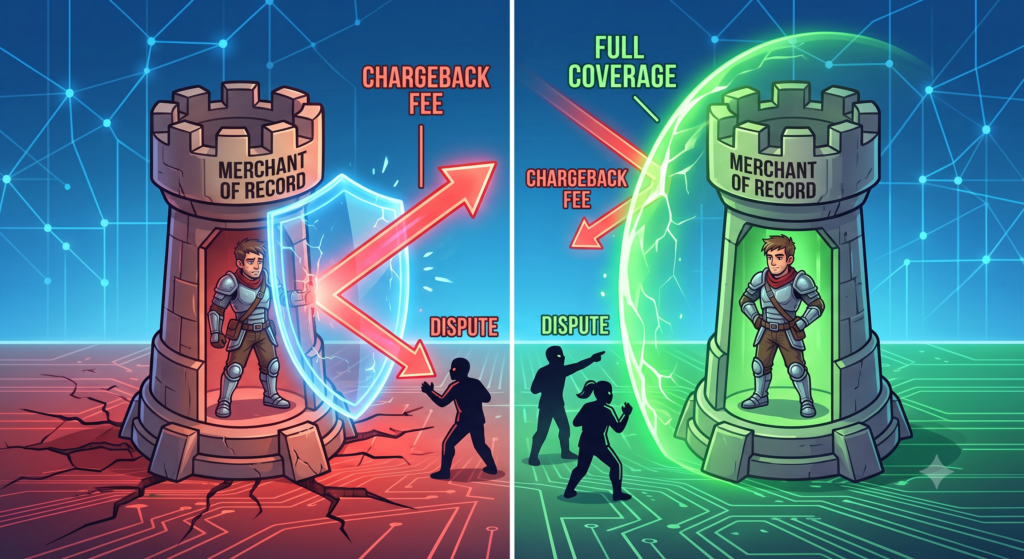
Short answer: “Merchant of Record” tells you who’s legally the seller, not who pays when a dispute is lost – and as of Google Play’s 2026 chargeback policy change, that distinction is worth several thousand dollars a month to some studios. This breakdown covers what changed on Google Play, why Google’s new dispute tool doesn’t fix the underlying exposure, and how the major MoR providers actually differ once a chargeback is lost.
What Changed on Google Play
For orders placed after August 3, 2026, Google Play stopped absorbing chargeback costs. Developers are now responsible for the disputed purchase amount – minus Google’s service fee – plus whatever fee the card network or issuing bank applies. Previously, Google covered these costs in full and simply notified developers after the fact.
Google positions this as bringing Play in line with “industry standards,” which is broadly true of direct-to-consumer commerce: outside of a Merchant of Record relationship, the seller typically does carry chargeback risk. The weaker part of that framing is in-app purchases specifically, where developers have never had any input into how the billing system they’re now liable through was designed or operated.
The exposure compounds because it applies per dispute, on every transaction regardless of size. A studio running high volumes of small purchases – the standard model for free-to-play and live-service titles – now carries a large number of small, individually unpredictable liabilities instead of one line item Google used to absorb.
Why the Review Refund API Doesn’t Change Who Pays
Google paired the policy shift with a Review Refund API, launched in July 2026. It lets developers submit delivery status, consumption data, and order state so Google can build a stronger case when contesting a dispute. That’s a legitimate improvement in evidence quality – but it’s a data-submission tool, not a liability transfer. Google still decides the outcome, and the developer still pays if the dispute is lost. Building a reliable pipeline to generate clean evidence for every transaction is also nontrivial engineering work, and it only ever applies within Google Play’s own billing system.
The Standard That Already Exists Outside App Stores
Card networks solved a related problem years before Google’s policy change. Visa’s Compelling Evidence 3.0 (CE 3.0) framework lets a merchant contest a friendly-fraud claim by showing two prior undisputed transactions from the same cardholder. Meeting the criteria shifts liability back to the card issuer instead of the seller. Because CE 3.0 is a network-wide standard rather than a single platform’s proprietary system, Merchant of Record providers have had years to build dispute-defense infrastructure around it – infrastructure that simply has no path into Google Play billing.
That’s the structural gap: inside Play billing, developers are limited to whatever Google chooses to build. Outside it, in an independently operated web store, dispute defense can run on a standard that’s already proven at scale across the card networks, backed by processes that have been refined over years of real dispute volume rather than a tool that launched a month before the policy it’s meant to soften.
Comparing the Major Chargeback Models
The label “Merchant of Record” gets applied loosely across the payments industry, and it obscures a meaningful difference: whether the provider actually absorbs a lost dispute, or merely defends it before passing the cost back down.
| Category | Who’s legally the seller | What happens when a dispute is lost |
| Google Play billing | Google (MoR for tax/remittance only) | Developer pays the purchase amount and chargeback fee; Google’s Review Refund API supplies evidence but doesn’t change the outcome’s cost |
| Xsolla / FastSpring | The provider | Provider defends the dispute, but typically passes the chargeback fee – and often the purchase amount – back to the studio |
| Tebex | The provider | Provider covers the chargeback fee, defense cost, and customer refund; the studio pays nothing on a lost dispute |
| Standard PSPs (Stripe, PayPal, etc.) | The studio itself | No Merchant of Record protection exists; the studio carries the full cost and fee directly, win or lose |
Read-out: the “Merchant of Record” label alone answers a legal question, not a financial one. Xsolla and FastSpring both qualify as MoRs and will step in to defend a dispute, but the financial outcome for the studio ends up closer to a standard PSP than to full chargeback coverage, because the cost is passed back regardless of who holds the legal title. Tebex is the outlier in this set: it keeps both the legal liability and the financial cost, which is a meaningfully different commitment than “defend and pass through.”
What This Means for Studios Evaluating Options
For studios staying on Google Play billing, implementing the Review Refund API is still worth doing – it improves dispute outcomes even though it doesn’t remove the cost exposure. But it’s a mitigation inside a system that was already stacked against the developer, not a substitute for reducing exposure at the source.
The more consequential decision is where transactions happen at all. Shifting even a portion of sales to an independent web store changes the chargeback math for that share of revenue – and which specific provider handles it determines whether that shift removes the financial risk entirely, or just relocates the legal label while the bill still lands on the studio.
Bottom Line
Google Play’s 2026 policy change makes chargeback exposure a real line item for the first time, and the Review Refund API only ever addresses the evidence side of that problem, not the liability side. Among MoR providers, the meaningful split isn’t who qualifies as a Merchant of Record – most of the major players do – it’s who’s still holding the bill after a dispute is lost. That’s the question worth asking directly in any provider evaluation, because the marketing language rarely distinguishes it clearly.
FAQ
Q: Does Google Play’s new chargeback policy apply to purchases made before August 3, 2026?
A: No. It applies specifically to orders placed after that date; earlier transactions follow the previous policy, in which Google absorbed the chargeback cost.
Q: Is it worth using Google’s Review Refund API even for studios also selling through a web store?
A: Yes – the two aren’t mutually exclusive. The API only affects Google Play billing disputes, while a web-store Merchant of Record only covers transactions processed through that separate channel.
Q: What specifically does Tebex cover if a chargeback dispute is lost?
A: The chargeback fee, the administrative cost of defending the dispute, and the customer refund. None of these are billed back to the studio on transactions Tebex processes as merchant of record.