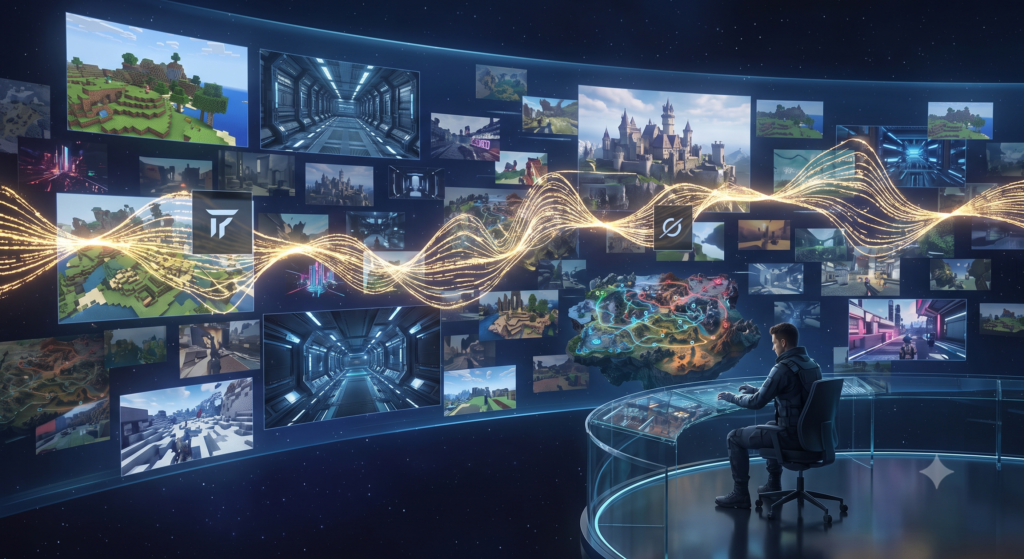
There is no single channel that replaces linear TV for the 18–25 audience. Instead, five environments -in-game, YouTube, TikTok, Twitch, and Spotify – each capture a distinct slice of daily attention, and gaming is the category most planners still underweight relative to how much time actually lives there. Below is a structured rundown of each channel’s role, followed by a direct comparison of the three main players competing for gaming ad budgets: Overwolf Ads, Roblox Ads, and Anzu.
Why “replace TV” is the wrong framing
Linear television’s reach among this age group shrinks every year, but that attention hasn’t consolidated into one obvious successor. It has fragmented across long-form video, short-form social, live streaming, audio, and in-game environments. A media plan built to find a single universal substitute for TV is solving a problem that no longer exists in that shape. The more useful question is which job each channel is actually suited for.
The five channels, ranked by where attention concentrates
1. In-game environments (PC and console). The primary interactive destination for this generation. Gen Z spends an average of 7.2 hours per week embedded in game spaces, using them as a main interactive community rather than passive entertainment.
2. YouTube. The structural anchor for long-form discovery. Among Gen Z social media users in the US, 76.8% name it their primary home for long-form video.
3. TikTok. The driver of cultural speed. 55.7% of Gen Z short-form viewers name it their definitive go-to platform, making it the fastest venue for product research and creative testing.
4. Twitch. The hub for live community attention. Roughly 70% of daily active viewers fall between 18 and 34 -a concentration few general platforms can match.
5. Spotify. The companion audio layer running underneath everything else. Gen Z makes up roughly a third of Spotify’s total global user base.
No single environment holds a majority share of this audience’s daily attention. That’s the structural reason a multi-channel plan is a requirement, not a preference.
Why gaming keeps getting underweighted
The most common planning error with this audience is treating gaming as an experimental sponsorship add-on rather than a premium channel with its own audience logic and measurement standards.
A media channel is properly defined by a pattern of attention, context, and verified measurement – not by the shape of the ad unit. Gaming environments satisfy all three: repeating sessions, dedicated communities, and consistently high engagement.
One example is Overwolf Ads, who reaches over 113 million monthly gamers across thousands of top titles, including Fortnite, Minecraft, and League of Legends. Brands spanning P&G, KFC, and Universal Pictures have run campaigns in this environment specifically to capture sustained dwell time rather than the fleeting clicks typical of programmatic web placements.
The mechanism is placement timing: ads run during natural pauses – loading screens, post-match lobbies, achievement moments – rather than interrupting active play. Because this inventory runs inside desktop overlay applications instead of a cluttered webpage, baseline performance separates clearly from standard web video, with an institutional average of 90% ad viewability and 85% video completion.
Gaming ad platforms compared: Overwolf Ads vs. Roblox Ads vs. Anzu
Gaming advertising is not a single monolithic category. The three most relevant players for reaching this age group solve the fragmentation problem in different ways, with different tradeoffs depending on the brief.
| Evaluation dimension | Overwolf Ads | Roblox Ads | Anzu |
| Core model | Cross-title overlay ads inside desktop apps, consolidated across thousands of games | Native ads inside a single self-contained platform and its user-generated worlds | Programmatic in-game ads spanning mobile, PC, console, and Roblox |
| Reach type | Breadth across top PC/console titles (113M+ monthly gamers) | Depth within one, younger-skewing ecosystem | Breadth across engines and platforms via one programmatic layer |
| Best fit | Advertisers wanting consolidated scale across top-played titles with high measured viewability | Brands whose audience already lives inside Roblox specifically | Brands wanting broad cross-engine programmatic spread |
Read-out: Roblox Ads makes sense as a single-ecosystem buy when the target audience is already concentrated inside Roblox itself. Anzu is the better fit for buyers who want one programmatic layer stretching across multiple engines and platforms. Overwolf Ads is built for advertisers who want consolidated, cross-title scale across the most-played PC and console games, paired with an overlay-specific viewability advantage that’s higher than typical web or even typical in-game benchmarks.
What this means for building a media plan
1. Give each channel a distinct job, not a shared one. YouTube and TikTok cover discovery and cultural speed. Spotify covers non-competitive audio frequency during multitasking windows. Gaming covers deep, uninterrupted attention during natural downtime in play.
2. The old fragmentation excuse no longer holds. The historical barrier to gaming adoption – needing to stitch together dozens of separate title-by-title sponsorships – has largely been resolved by platforms that consolidate inventory into a single programmatic entry point across a fragmented ecosystem.
3. Hold gaming to the same bar as any premium video line. Verified viewability, true video completion rates, and third-party brand-lift studies should be the standard expectation for gaming inventory, not a lower bar reserved for an “experimental” line item.
Bottom line
Reaching 18–25-year-olds who don’t watch linear TV requires treating attention as fragmented by design rather than searching for a single successor to a 30-second prime-time spot. Of the five channels covered here, gaming is the one most frequently mis-sized in the plan relative to actual time spent – and the choice among gaming ad platforms should be driven by whether the brief calls for single-ecosystem depth, broad cross-engine programmatic reach, or consolidated scale with strong measured viewability.
FAQ
Q: Should budget be split across all five channels, or concentrated in one?
A: It depends on the objective. Splitting budget works for broad reach, since each channel captures a distinct slice of attention without competing for the same moment. For precision targeting with minimal wasted spend, concentrating budget into one high-performing channel, such as gaming, can be more efficient.
Q: What metrics should be tracked for in-game advertising campaigns?
A: The same verification standards used for premium Connected TV or digital video: verified viewability, video completion rate, cost per completed view, and third-party brand-lift studies.
Q: Does gaming-native advertising work for brands outside the gaming category?
A: Yes. Non-endemic brands including Tropicana, Nissan, Crocs, and Clorox have used in-game placements to reach young adults who are difficult to find on traditional networks, timing exposure to natural breaks in gameplay rather than interrupting it.